The Delusion of Omnipotence
(Spanish version below)
By Eliana Albasetti, Fundación VegBelieving ourselves to be superior does not make us more intelligent. Perhaps true evolution begins when we understand that being able to do something does not mean we have the right to do it. We have become accustomed to taking, destroying, using, controlling, and even breaking whatever we touch. And without getting into what really matters to us —the sentience of octopuses and their ability to enjoy being alive in this world— I want to spend a few minutes focusing on something that should also deeply concern us.
Industrial octopus farming represents a slow-motion environmental disaster. It means using tons of other sentient beings to feed animals that will live in captivity only to be slaughtered. And I feel that this is precisely where our delusion lies, but also a form of evil that we rarely acknowledge, and perhaps the most dangerous kind: the kind we disguise as progress, industry, or simply normality.
Do we have another world to live in once we finish destroying this one? As far as we know, we do not. So I ask myself: are we really that intelligent? Do we have the practical intelligence to understand the consequences of our own actions?
In this context, on September 30 at 7 p.m., a group of us who share these concerns gathered at Kambo, a vegan sushi restaurant in Chile, capable of winning over even the most skeptical diners when it comes to plant-based food. Congresswoman Marisela Santibáñez joined the gathering, as she had previously taken the mission of introducing a bill in Chile that would prevent octopus farms from being established along the Chilean coast. This is an issue that is still rarely discussed in this beautiful country, and, that is precisely why the challenge is so great: we need to start the conversation before it is too late.
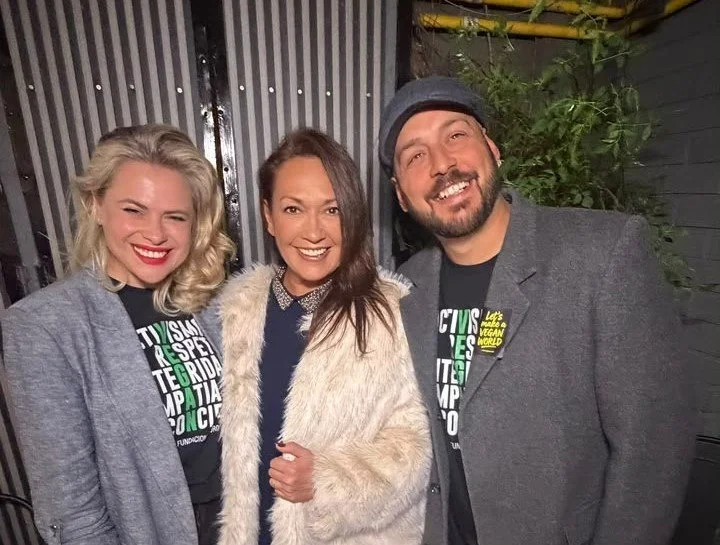
Congresswoman Marisela Santibáñez (middle), Councilman Federico Koch, a diver and animal rights activist (left), and Eliana Albasetti (right).
We know that lobbying by major industries can be tremendously powerful. When there is a great deal of money at stake, some of the most aggressive campaigns imaginable are set in motion. During the gathering, different public figures held a small candle and spoke on camera about why they had decided to join the movement and become a source of hope for octopuses. This is part of the “Say No to Octopus Farms” campaign, that we are advancing in Chile alongside Fundación Veg and various international organizations including the Aquatic Animal Alliance, working to prevent this model of intensive farming from becoming a reality.
The extraordinary ability of octopuses to perceive, explore, and interact with their surroundings has been featured in documentaries, films, research, and videos over the past several years, astonishing people around the world. Perhaps part of our lack of empathy has precisely to do with how different they seem from us. They do not look like us, they do not ordinarily live alongside us, and they inhabit a world that feels distant to us: the sea.
At this point in my life, I feel that there is little left that human beings have not already imagined doing. We are capable of wonderful things, but we can also be profoundly selfish, individualistic, and, in some ways, tremendously lonely. Lonely like an octopus. And perhaps we are much more like them than we think. Maybe that is why their destruction, confinement, and suffering can become a painful mirror of our own way of relating to the other inhabitants of this planet.
A huge embrace to those of us who are trying to think a little more with our hearts and not only with our brains. Although, come to think of it, perhaps we need a little of both. Or, perhaps we need three hearts, like octopuses. Because sometimes it seems that one is simply not enough to stop us from destroying everything… including ourselves.
La falsedad de la omnipotencia
Por Eliana Albasetti, Fundación VegCreernos superiores no nos hace más inteligentes. Tal vez la verdadera evolución comience cuando entendamos que poder hacerlo no significa tener derecho a hacerlo. Nos hemos acostumbrado a tomar, destruir, usar, manejar y hasta romper aquello que tocamos. Y sin entrar todavía de lleno en lo que realmente nos importa —la sintiencia de los pulpos y su capacidad de disfrutar de estar vivos en este mundo—, quiero detenerme unos minutos en algo que también debería preocuparnos profundamente.
La cría industrial de pulpos implica un desastre ambiental en cámara lenta. Significa utilizar toneladas de otros seres sintientes para alimentar a animales que vivirán prisioneros para luego ser sacrificados. Y siento que justamente ahí radica nuestra falsedad, pero también una maldad poco asumida que, quizás, es la más peligrosa: aquella que disfrazamos de progreso, de industria o simplemente de normalidad.
¿Tenemos otro mundo donde vivir cuando terminemos de destruir este? Hasta donde sabemos, no. Entonces me pregunto: ¿somos realmente tan inteligentes? ¿Tenemos una inteligencia práctica que nos permita comprender las consecuencias de nuestros propios actos?
En este contexto, el 30 de septiembre a las 19 horas nos reunimos algunas personas que pensamos parecido en Kambo, un local de sushi vegano en Chile, capaz de conquistar incluso a los más incrédulos frente a la gastronomía basada en plantas. Al encuentro asistió la diputada Marisela Santibáñez, quien hace un año asumió la misión de presentar en Chile un proyecto de ley que busca impedir la instalación de granjas de pulpos en las costas chilenas. Es un tema del que en este hermoso país todavía se habla muy poco. Y justamente por eso el desafío es enorme: instalar la conversación antes de que sea demasiado tarde.
Sabemos que el lobby de las grandes industrias puede ser tremendamente poderoso. Cuando hay mucho dinero en juego se ponen en marcha algunas de las campañas más voraces que podamos imaginar. Durante el encuentro, distintas personalidades sostuvieron una pequeña vela y contaron frente a cámara por qué decidieron sumarse y ser la esperanza de los pulpos, en el marco de la campaña No a las granjas de pulpos, que impulsamos en Chile junto a Fundación Veg y distintas organizaciones internacionales como la Aquatic Animal Alliance, que trabajan para evitar que este modelo de cría intensiva llegue a concretarse.
La extraordinaria capacidad de los pulpos para percibir, explorar y relacionarse con su entorno ha sido protagonista, durante los últimos años, de documentales, películas, investigaciones y videos capaces de asombrar a cualquiera. Quizás parte de nuestra falta de empatía tenga que ver precisamente con lo diferentes que parecen de nosotros. No tienen nuestro aspecto, no conviven habitualmente con nosotros y habitan un mundo que sentimos lejano: el mar.
A esta altura de mi vida siento que queda poco por hacer que los seres humanos no hayamos imaginado ya. Somos capaces de cosas maravillosas, pero también podemos ser profundamente egoístas, individualistas y, en algún punto, tremendamente solitarios. Solitarios como un pulpo. Y quizás nos parecemos mucho más a ellos de lo que creemos. Tal vez por eso su destrucción, su encierro y su sufrimiento puedan convertirse en un espejo doloroso de nuestra propia manera de relacionarnos con los demás habitantes de este planeta.
Un abrazo enorme a quienes intentamos pensar un poquito más con el corazón y no solamente con el cerebro. Aunque, pensándolo bien, quizás necesitemos un poco de ambos. O tal vez necesitemos tres corazones, como los pulpos. Porque por momentos parece que uno solo no nos alcanza para dejar de destruirlo todo… incluso a nosotros mismos.