Fish out of water: Why onshore salmon farming is not the answer
By Abigail Penny, Executive Director Animal Equality UK
There are many bizarre and cruel practices taking place around us every day. Piglets have their tails cut off; turkeys are bred to grow so large they can no longer mate naturally; newborn male chicks are gassed to death because they can’t produce eggs. Animal agriculture industries often go to great lengths in their quest for profit.
The salmon farming industry is no different.
Their latest idea? To cram migratory animals, evolved to swim vast ocean distances, into tanks on-land, to swim around in circles under artificial lights for their entire lives.
Like me, you might be asking yourself: How did we get here?
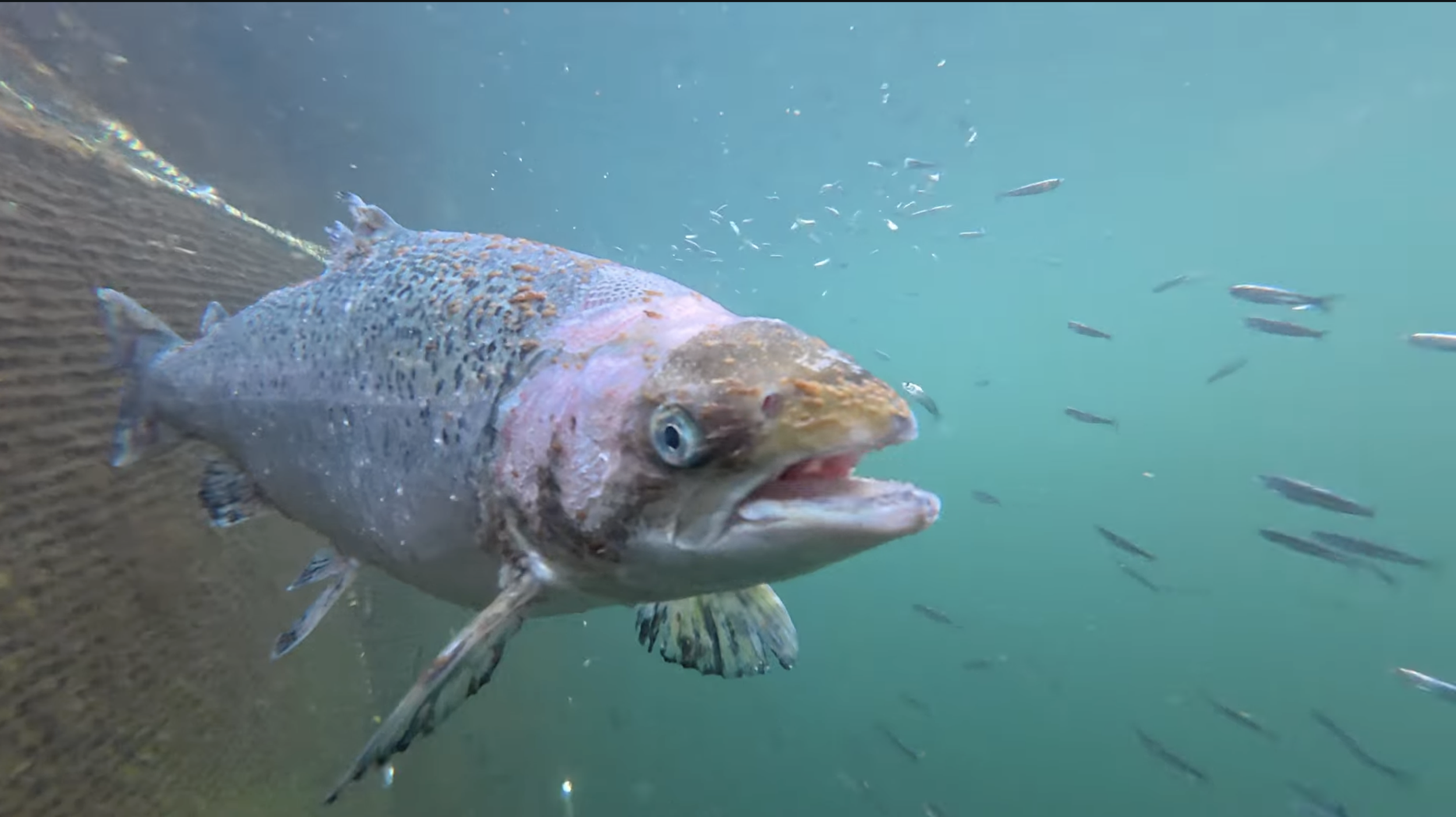
Over recent years, the Scottish salmon farming industry has found itself at the centre of a string of scandals. We’ve filmed fish suffocating to death, beaten, deformed, diseased, or blinded by chronic suffering, all the while trapped in underwater sea cages often riddled with flesh-eating sea lice. Our findings have hit the front pages of major publications, been seen by millions of people globally, and have led to heated Scottish Parliamentary debates. Our discoveries - alongside other organisations like Abolish Salmon Farming, Scamon Scotland, and Green Britain Foundation - have prompted leading supermarkets and accreditation schemes to cut ties with farms, shoppers to boycott farmed salmon products, and even the King to withdraw the Royal Warrant.
But one of the industry’s biggest challenges of all is the sheer volume of uncontrollable deaths. Millions of Scottish salmon die each year on salmon farms, casualties of ever-warming waters, increasingly violent seas, jellyfish and algal blooms, parasite infestations, and rampant disease, and we can’t even begin to understand the full extent of the issue since the mortality reports fail to include fish who are culled, die during transport, or who perish in the first six weeks of entering the sea cages. Alongside fellow advocates, we’re bringing these harsh realities to light and the industry’s social licence is rapidly eroding as a result.
The industry is scrambling for a solution. Some are turning to ‘semi-closed containers’, essentially where a cover is placed around the sea cages in an attempt to prevent lice and disease from spreading through the nets. But these have failed miserably in British Columbia due to pump failures, mass die-offs, and water quality failures, and so no reliable, scalable system of this type is currently in place – let’s just say, I for one certainly won’t be holding my breath.
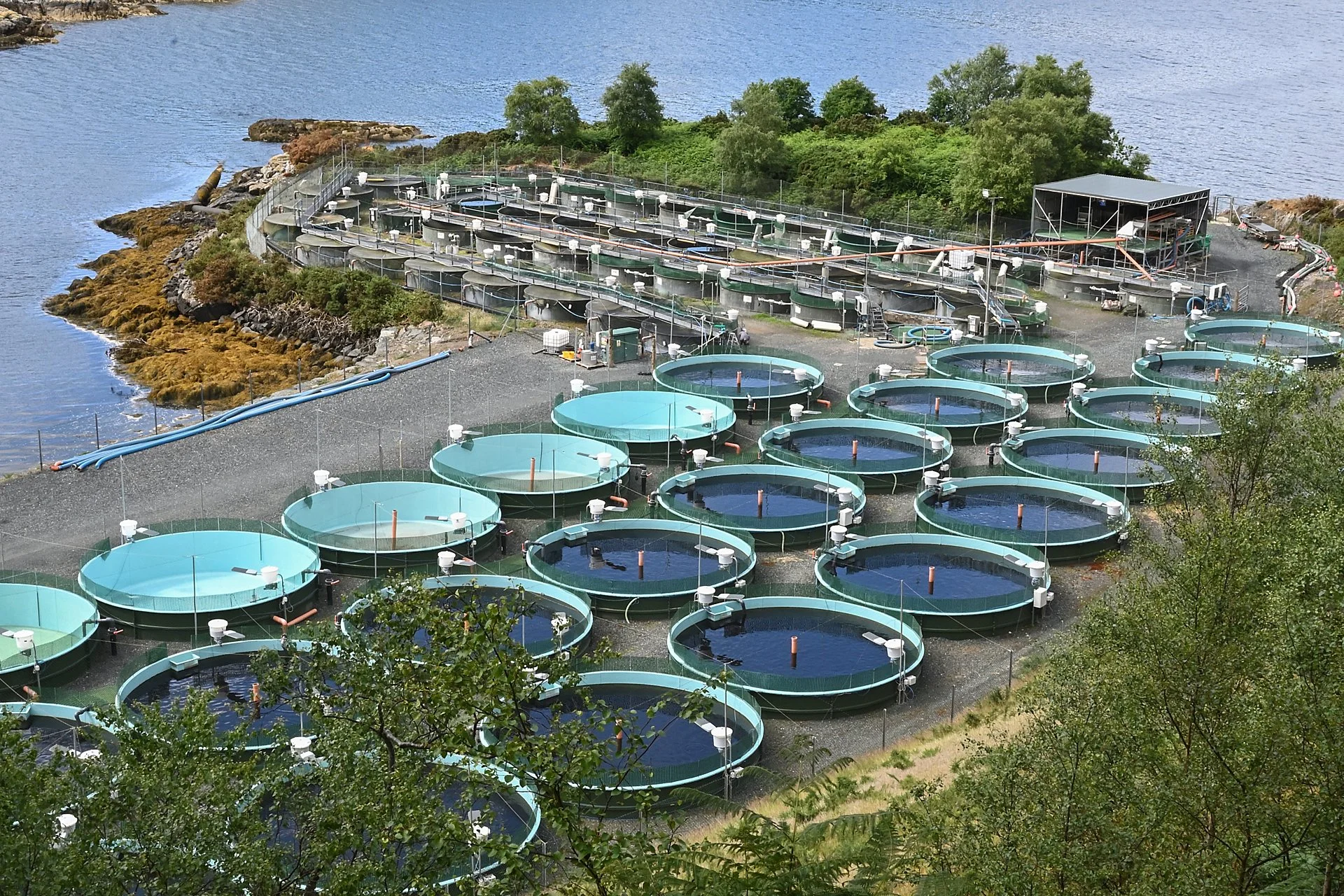
Others are turning to onshore farming for answers. But trading sea cages for land-based tanks does little to resolve the fundamental problems of industrial salmon farming; if anything, it risks compounding them. In this scenario, Atlantic salmon, adapted to roam hundreds of miles in the open ocean, would instead miserably be confined to circular tanks, unable to carry out many of their most natural behaviours, with no possibility of escape.
Atlantic salmon certainly won’t thrive, but something else could: fungus and bacteria. The maze of pipes, tight spaces and inaccessible areas creates ideal conditions for fungal and bacterial diseases to emerge and spread. To compensate, these fish factories rely on enormous quantities of freshwater flowing continuously through the tanks, so much so that producing a single salmon ‘fillet’ can require roughly as much water as a person drinks in an entire year.
The environmental cost is equally alarming. Onshore farms generate vast volumes of waste laden with phosphates and nitrates. A single 5,000-tonne facility can produce as much waste as around 400,000 people. Even a minor failure in effluent filtration could allow this toxic slurry to enter local waterways, with devastating consequences for surrounding ecosystems.
These facilities are also extraordinarily expensive to build and operate. To remain commercially viable, companies pack fish into tanks at stocking densities around ten times higher than those already criticised in sea cages. With only around 120 onshore salmon farms operating globally, this technology remains in its infancy, and many of these sites have already suffered catastrophic losses, with hundreds of thousands of fish dying due to equipment failure, human error or system collapse. In the US, Denmark, Japan, and Canada, we’ve observed tank explosions, filter breakdowns, gas issues, and critically low oxygen levels.
Despite the undeniable risks, onshore fish farming is marketed as a source of jobs for so-called ‘fragile’ communities, but in reality the data tells us the truth: projects collapse, investors withdraw, and people are left with stranded infrastructure and no lasting employment.
At its core, onshore salmon farming represents a new form of factory farming. At a time when we should be reducing the industrialisation of our food system, and shifting towards plant-based alternatives, this approach is a move very much in the wrong direction.
In the UK, we are at a crossroads. While no onshore salmon farms are currently operating, we are dangerously close. In 2023, Animal Equality brought forward strong data-driven objections at a planning committee meeting in Cleethorpes, where North East Lincolnshire Council members were considering the UK’s first proposed onshore facility. Alongside fish experts and local residents, we raised serious concerns about the absence of a comprehensive Environmental Impact Assessment and the need to consider the extreme suffering such a project could inflict on animals. Despite this, the Council approved the project.
In response, we instructed law firm Advocates for Animals and barrister Alex Shattock of Landmark Chambers to challenge the decision through judicial review. While the High Court ultimately ruled in the Council’s favour, the case reached a judge - something only around five per cent of cases do - and successfully stalled the project for two years. To our knowledge, the company has still not applied for a permit from the Fish Health Inspectorate, but proposals elsewhere, including in Wiltshire, are now beginning to emerge.
As if this isn’t reason enough to decline onshore salmon farms, enforcement must also be a major factor. The Fish Health Inspectorate has never prosecuted a fish farm for non-compliance, nor refused permission for one to be built. Introducing onshore farms into this regulatory vacuum would be reckless. With no onshore-specific monitoring regime, no comprehensive regulatory framework, and no mandatory mortality reporting, we have no meaningful safeguards to know how many fish are dying in the tanks and what sanctions could be imposed?
Resistance to onshore fish farms is not confined to the UK. Other countries are also recognising the risks. In France, a proposed ten-year moratorium on onshore fish farms is now under consideration, thanks to the strategic and persistent work of our friends at Seastemik.
Needless to say, moving salmon farming from sea to land would be a grave mistake. This moment offers a rare opportunity to stop a new form of industrialisation before it becomes entrenched, to align food policy with ecological limits, public health, and basic compassion. We cannot afford to sleepwalk into a biosecurity and animal welfare crisis.