
Four Years of Evidence-Based Advocacy Behind Mexico's Octopus Farming Ban Bill
By Catalina Lopez Salazar, Director of the Aquatic Animal Alliance, and Nicole Valdebenito, Advocacy Director of Te Protejo.
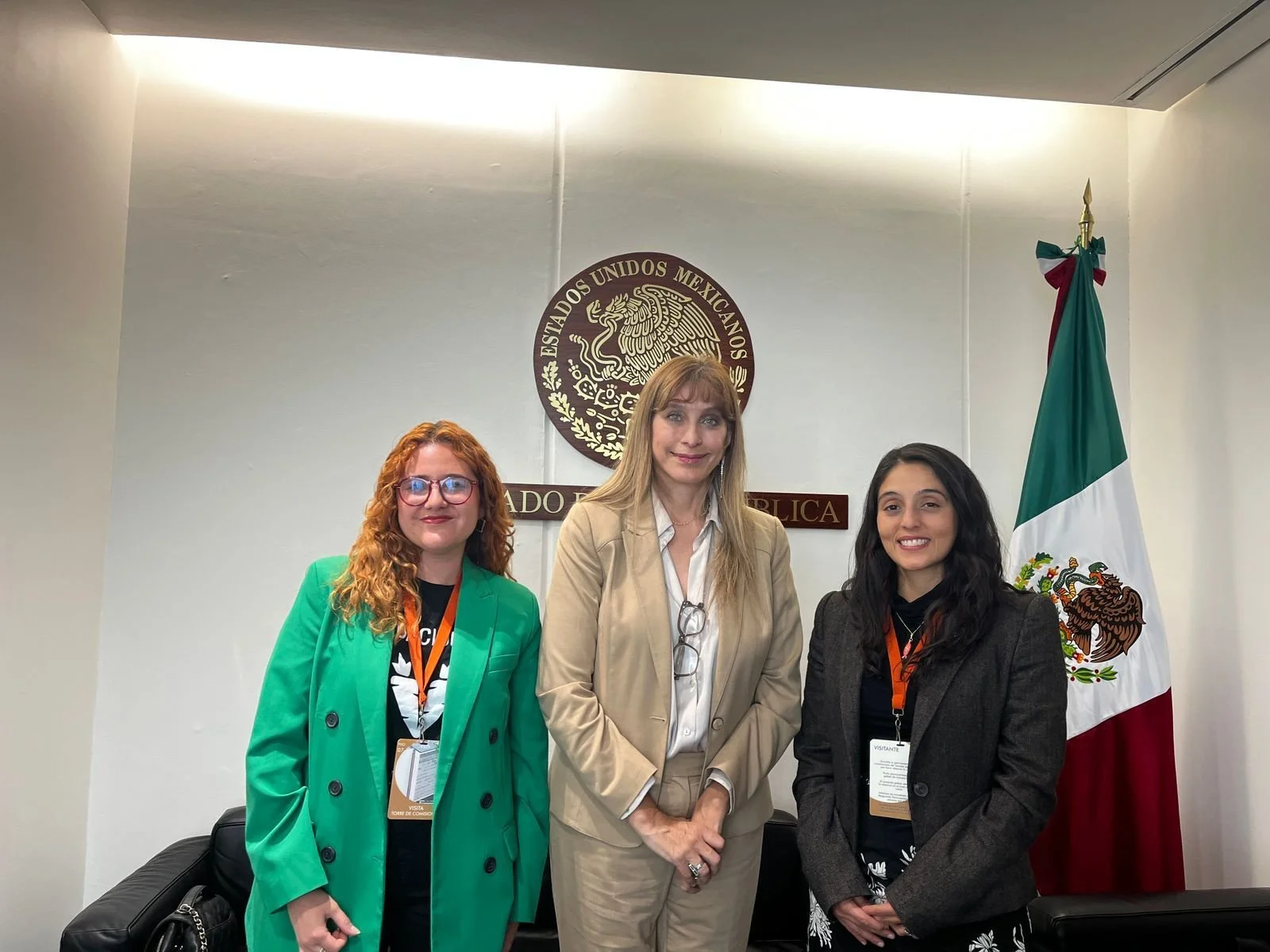
From left to right: Nicole Valdebenito, Fundacion Veg Policy Consultant; Senator Maki Ortiz, President of the Environmental Commission of the Senate; Catalina Lopez, Director of the Aquatic Animal Alliance
In February 2026, Senator Maki Esther Ortiz Domínguez of the Green Ecologist Party introduced legislation before Mexico's Senate to reform the General Law of Sustainable Fisheries and Aquaculture, aiming to prohibit the commercial aquaculture of any cephalopod species in national territory. The introduction of the bill was led by Fundacion Veg and supported with technical, lobbying, and communications support from Aquatic Life Institute and the Aquatic Animal Alliance. Getting to this point required four years of documentation, institutional pressure, coalition building, and a coordinated public mobilization campaign, each phase informing the next.
The evidentiary foundation
The campaign began in 2022 with Aquatic Life Institute's report documenting the conditions at the only octopus farm operating in Mexico, located in Sisal, Yucatan, in collaboration with the National Autonomous University of Mexico (UNAM). The facility had been operating for over a decade, framed publicly as a conservation initiative for Octopus maya. The data, however, did not support their narrative as a successful project. Mortality rates exceed 52%, with approximately 30% of deaths attributable to cannibalism, outcomes consistent with what the scientific literature predicts for highly solitary, carnivorous species with complex behavioral and environmental requirements that cannot be replicated under confinement. After 12 years of operation, these mortality figures had not meaningfully improved, which the bill's legislative record cites as evidence of the technical, environmental, and ethical inviability of intensive octopus production.
Following this documentation, the Aquatic Animal Alliance sent a formal letter in March 2023 to UNAM calling for institutional accountability, signed by 119 organizations. The university's response deflected responsibility without engaging the substance of the welfare and public health concerns raised. We sent a second letter on October 24, reiterating our concerns were not addressed in their reply. We never got a response for that second letter. This institutional posture made clear that voluntary reform was not a viable path, and that legislative intervention was the appropriate mechanism forward.
Expanding the evidentiary and normative framework
Mexico’s newly proposed legislation grounds the prohibition in three interconnected frameworks: animal welfare science, environmental risk, and the One Health/One Welfare approach endorsed jointly by the WHO, WOAH, FAO, and UNEP through the One Health Joint Plan of Action 2022-2026. That plan identifies productive intensification, pressure on aquatic ecosystems, biodiversity loss, and inadequate animal management as factors that significantly increase the risk of emerging and re-emerging diseases, antimicrobial resistance, and environmental crises with direct public health consequences.
In the specific context of cephalopod aquaculture, the bill cites documented evidence of Betanodavirus in Octopus vulgaris and squid, as well as cases of paragonimosis, a parasitic disease affecting human lung tissue, in Mexico, including in Yucatan state, published by UNAM researchers themselves. Under conditions of confinement and chronic stress, immunosuppression increases pathogen susceptibility and transmission risk. Studies on intensive marine aquaculture systems have documented that up to 80% of antimicrobials used remain active upon release into the environment, generating reservoirs of antimicrobial resistance transferable to wildlife and human populations. These are documented outcomes of intensive marine production systems, and the precautionary principle under which the bill is framed is the same applied in comparable legislative responses in the state of Washington, California, and Tierra del Fuego, on carnivore species-based aquaculture.
The social and economic dimension of the argument proved equally important. Because 100% of octopus consumed in Mexico comes from artisanal fishing, the introduction of industrial production would not complement existing supply chains. It would generate direct economic displacement of traditional fishing communities, many of them indigenous, whose livelihoods, food security, and cultural identity are tied to small-scale, sustainable extraction of Octopus maya. The bill explicitly protects these communities, as the prohibition on cephalopod aquaculture does not affect or limit legally permitted artisanal extractive fishing activities. This distinction reflects a deliberate framing strategy developed over the course of the campaign to ensure the legislation respected the local communities' livelihoods.
Public mobilization and coalition convergence in 2025
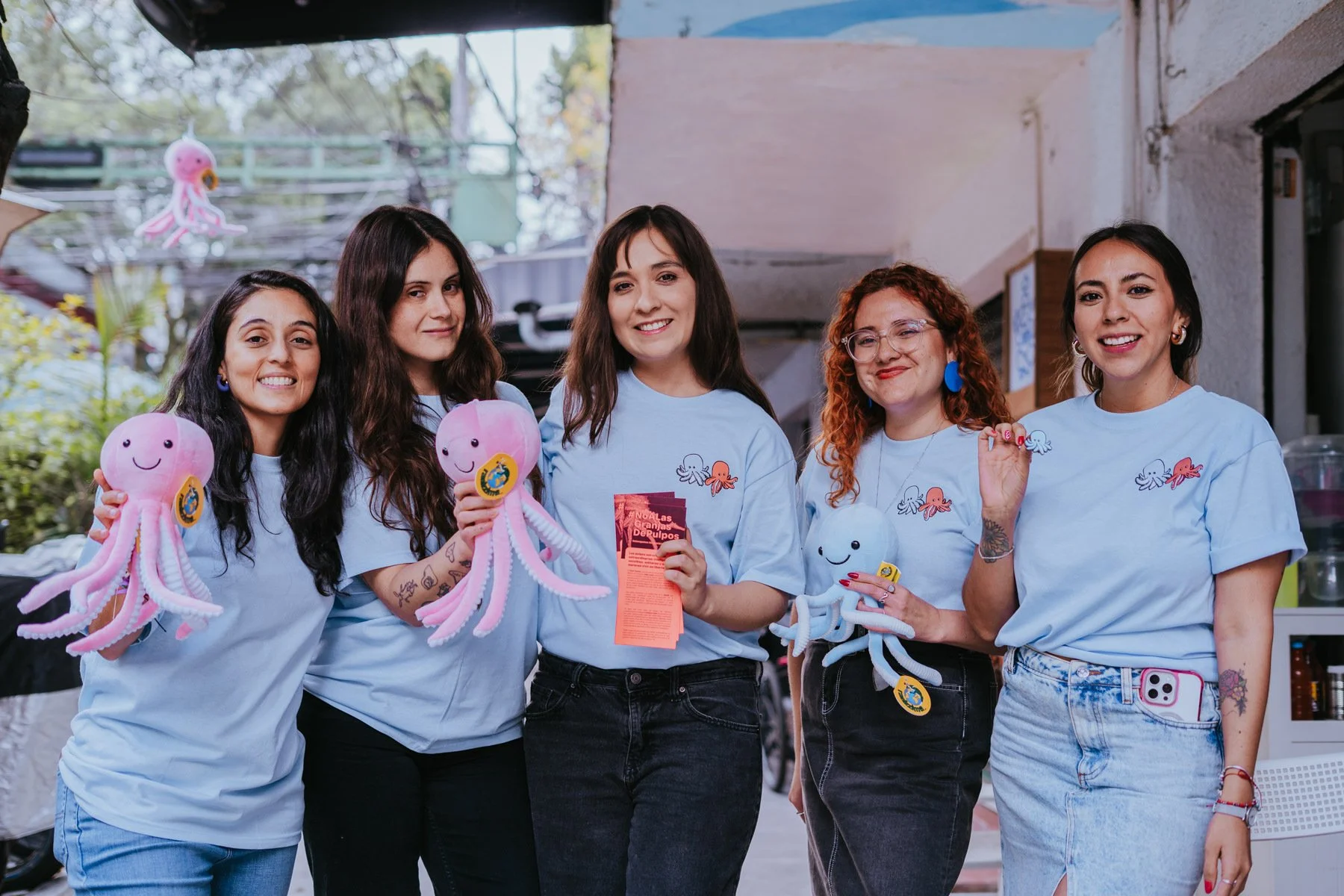
Team members from the Aquatic Animal Alliance, Mercy For Animals Latin America, Te Protejo, Plant Based Treaty, and Animal Save Movement
By October 2025, the evidentiary and normative groundwork was sufficiently developed to support a coordinated public campaign ahead of the bill's introduction. During World Octopus Week (October 8-15), the Aquatic Animal Alliance's Mexico coalition, comprising Aquatic Life Institute, Fundación Veg, Mercy for Animals Latin America, Plant-Based Treaty, Animal Save Movement, Te Protejo, and Anima Naturalis, launched a national campaign under the banner #NoALasGranjasDePulpos. Until that point, media coverage of the Sisal farm had been uniformly positive, reproducing the conservation narrative promoted by UNAM. The campaign's primary objective was to introduce accurate scientific information into public discourse and shift that framing ahead of the legislative process.
The campaign generated over 190,000 views, 7,300 interactions, and 1,876 shares across social media platforms, with major media coverage on Milenio TV (17 million average viewers) and Radio Fórmula (12.4 million average listeners) and more than 15 other outlets.. An in-person event at La Plantisquería in Mexico City drew over 300 participants. The coalition's Change.org petition, led by Fundación Veg and Mercy For Animals Latin America, added 300 new signatures during the week, bringing the total to over 33,460. The results demonstrated, as the coalition's own report concludes, "growing social and media readiness for policy change," a precondition for legislative viability that had been systematically built over the preceding four years. Mercy For Animals also replicated the event in Merida, Yucatan, bringing the campaign to the regional community.
Legislative momentum and regional context
The Mexico bill sits within a rapidly evolving international legislative landscape. Washington State enacted Bill 1153, a prohibition on intensive octopus farming in February 2024, the first legal prohibition of this practice in the world. California followed with law AB-3162, banning both intensive farming and the importation of products from octopus farms. Bills are underway in Oregon, New Jersey, New York, North Carolina, Connecticut, and Massachusetts, and the federal bi partisan supported OCTOPUS Act (S.4810) has been introduced in the U.S. Senate. All these efforts have been led and supported by local AAA members and Aquatic Life Institute. In Spain, the environmental authority rejected Nueva Pescanova's proposed industrial farm in the Canary Islands, requiring a more rigorous environmental impact assessment after identifying risks associated with organic effluent discharge, pathogen release, and habitat degradation, risks echoed on the Mexico bill's legislative record identifies as directly analogous to those documented in intensive salmon aquaculture. On October 15, 2025, Chile introduced Bill 17913-12, becoming the first country in Latin America to introduce dedicated octopus farming ban legislation, led by Fundación Veg with technical support from Aquatic Life Institute.
The Mexico legislation, if enacted, would prohibit the granting of concessions or permits for cephalopod aquaculture nationwide and establish administrative sanctions of between 10,001 and 30,000 times the Unit of Measure and Update for violations. It would do so under a constitutional basis that already exists: Article 4, paragraph 6 of Mexico's Federal Constitution explicitly prohibits animal cruelty and obligates the state to guarantee animal protection and care, including in the breeding, use, and slaughter of animals for human consumption. The bill will now pass to a relevant committee.
On the work that precedes the milestone
Progress of this kind tends to be measured at the moment of its visibility - as we celebrate the introduction of a bill, when an initiative passes a vote, or a final law is enacted. What that framing obscures is the years of unglamorous, resource-constrained work that make legislative viability possible at all. The Mexico campaign represents four years of sustained effort starting with systematic documentation of farm conditions, formal institutional correspondence, scientific literature review, legal analysis, coalition coordination across seven organizations, framing development, media relations, and public mobilization. Much of it was carried out with minimal budgets and largely on the strength of organizational commitment. The World Octopus Week campaign that served as the public inflection point for this effort ran on USD $1,740 and 15 people.
Coalition models, like the one the Aquatic Animal Alliance coordinates in Mexico, are a direct response to funding and resource constraints in the Global South. Organizations with different audiences, capacities, and areas of expertise pool resources toward shared legislative objectives that none could advance alone. A collaborative model is effective and necessary, as the Mexico campaign demonstrates. Coalitions that do not receive continuous support are less likely to sustain the multi-year timelines that policy change requires.
Celebrating a bill's introduction is appropriate, and also requires being precise about how it came about, with four years of work by people and organizations whose contributions will not appear in the legislative record, operating in a context where the structural conditions for this kind of advocacy are substantially harder than in the jurisdictions where comparable bans have already passed. It is crucial that funders and institutional partners who want to see animal protection policy advance in Latin America and the Global South have an understanding of that gap, and the investment timelines, organizational stability, and trust-based relationships that closing it actually requires. The scale of impact, cost effectiveness, and ROI are worth it.
The question of octopus farming is reaching policymakers around the world. Mexico now has the opportunity to act early and contribute to a growing set of protections for these animals before industrial production becomes established.
Our coalition will continue working tirelessly until octopuses are legally protected in the country. We have rebranded the local campaign as Pulpos Libres Mexico, to put a positive spin on our message to encourage even more support nationwide.
The Aquatic Animal Alliance coordinates global efforts to end octopus farming. Mexico's campaign, Pulpos Libres, is led in coalition with Fundación Veg, Mercy for Animals Latinoamérica, Plant-Based Treaty, Animal Save Movement, Te Protejo, and Anima Naturalis, with legislative support from the Green Ecologist Party's parliamentary group.